How Mobike Has Achieved Success in China
Hi there! Welcome back to my blog!
In this blog, I would like to explore a once red-hot phenomenon ― bicycle-sharing system industry. Through one of the most representative companies within the industry, Mobike, I will critically evaluate the digital business model it has used to help lead it to its prosperity in China.
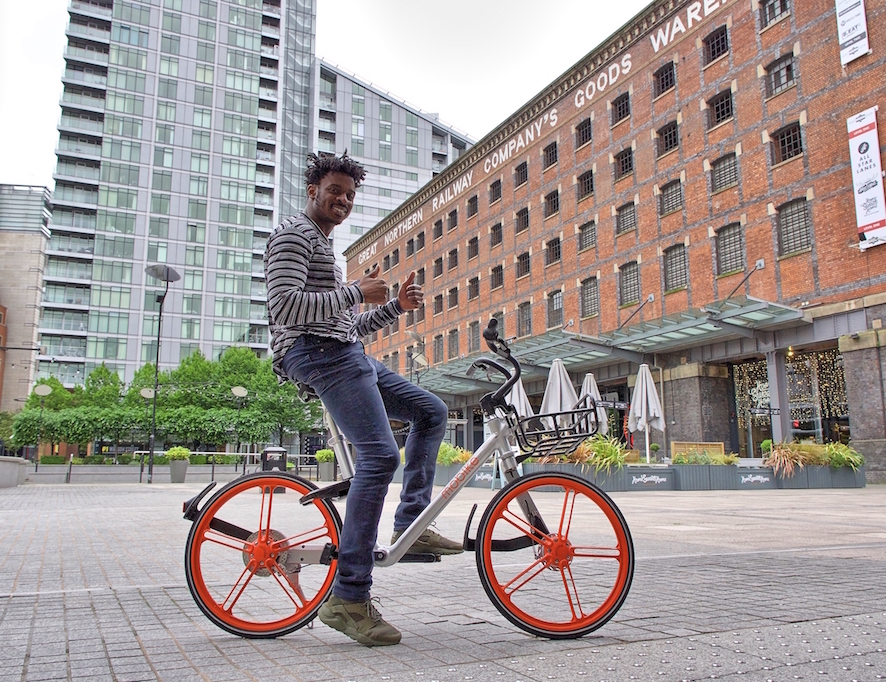
Retrieved from https://mobike.com/uk/
If you walk on a street of any main cities in China, you may be shocked by the colourful sharing bikes aligned parking around. Different colors of bikes represent their different owner companies ― Mobike, Ofo, Bluegogo, hellobike, … These sharing bikes have not only constituted a ‘rainbow like’ street view of China, but also implicated an enormous market capital and great profitable potential.

Retrieved from https://www.caixinglobal.com/2017-05-23/china-to-roll-out-tougher-rules-on-bike-sharing-deposits-101093496.html
Amongst the diverse bike-sharing companies in China, Mobike is arguably the most successful one. First launched in Shanghai in 2016, Mobike has since expanded into 160 cities around the world (Mobike, 2020). Before it was eventually purchased by a giant Chinese delivery company, Meituan, for $2.7 billion in 2018, it had raised more than $900 million from a number of investors such as Tencent, Foxconn, Hillhouse Capital and Warburg Pincus (Liao, 2019). In light of the financial performances, Mobike has been considered as successful in China.
How it works?
Mobike claims the mission of itself as ‘the perfect first & last mile solution’ (Mobike, 2020), which means that commuters may face the issue of being stuck a bit too far from their destination to walk, but too close to justify the cost or delay of hiring a taxi. Mobike is operated via an application of our smartphone, connecting commuters and the bikes, which are produced by Mobike’s manufacturers. The basic rationale of how it works can be seen from the below video and the image of its business model:
Retrieved from https://www.youtube.com/watch?v=Oz72w0VZaAc

Retrieved from https://steemit.com/business/@tetsurokondoh/9-businessmodels-in-2017-that-were-impressive-businessmodeldiagram
What makes it successful?
Circular Economy
Above all, although Mobike belongs to bicycle-sharing system, it is actually circular economy, rather than sharing economy. According to the definition from Investopedia, sharing economy is an economic model based as a peer-to-peer activity of acquiring, providing, or sharing access to goods and services (Chappelow, 2019). All the bikes that Mobike owns are produced by their cooperative manufacturers, but not the private assets of individuals. It is seen as a circular economy, because from the beginning of design, Mobike has sought to provide the energy saving and emission reduction of the whole life cycle of the bicycle (Mobike, 2020). In July 2018, it took the lead in proposing and implementing the ‘full life cycle environmental protection concept’, through the ‘3R’ principles (Reduce, Reuse, Recycle) carried out within all operating processes, including designing, procurement, production, launching into the marketing, operation, and scrapping (Bikebiz, 2019). Except for the environmental-friendly way of uses, I reckon there are three other reasons that contribute to the success of Mobike in China.
Convenience
As one of the first companies to implement the “docking-free” sharing-bikes in China (Mobike, 2020), Mobike has significantly accelerate the travel efficiency and solve the traffic congestion to people with a relatively low cost. The dockless parking feature is enabled by a GPS tracker so that customers can use their smartphones to locate, pay for and drop off their bikes in convenient locations. From my using experience, by making a deposit of CN¥99 and spending CN¥1-2 per hour, users can readily find available bikes nearby. All the bikes could be picked up and dropped off at anytime and anywhere without the confinement of the docking station, providing great convenience and user experience.
Collaboration
Despite that the sharing-bikes system has brought disruptive impact to bicycle retailers to certain extent, Mobike has been closely collaborating with a large number of different bicycle manufacturers all over China (Mobike, 2020). The digital business model of Mobike has not thoroughly subverted the whole traditional bicycle production industry. On the contrary, it helps add value by helping standardize the operation of bike sharing process, maximize bike utilization and promote the development of bike manufacturing industry (Gray, 2017).
Maintainability & Repairability
The condition and performance of the bike is monitored by “Internet of things” (IoT) technology which alerts Mobike when repairs are necessary (Please refer to my first blog if you are curious of what ‘IoT’ is!). Moreover, full-time maintenance teams are distributed to each city where Mobikes are in working to repair the bikes and conduct termly examining. As a result, the quality of Mobikes and the safety of their users can be secured and ensured.
In short, Mobike as a representative of circular economy has significantly solved the problems of waste of resource from production and scrap, air pollution, and helped to cope with traffic congestion and the digital disruption threatened to traditional bicycle manufacturers, through the way of how its digital business model works in China, which has led to a success. Although the bike-sharing system is still away from perfection, it is worth to noting its improvement and evolution within the future in digital economy era.
References list:
Bikebiz.com (2019) ‘Analysing the bike-sharing economy’. Retrieved on 5.3.2020 from https://www.bikebiz.com/analysing-the-bike-sharing-economy/
Chappelow, Jim (2019) ‘What is the Sharing Economy?’. Retrieved on 5.3.2020 from https://www.investopedia.com/terms/s/sharing-economy.asp
Dong, Tongjian. et al. (2017). ‘China to Roll Out Together Rules on Bike-Sharing Deposits’. Retrieved on 5.3.2020 from https://www.caixinglobal.com/2017-05-23/china-to-roll-out-tougher-rules-on-bike-sharing-deposits-101093496.html
Gray, Alex (2017). “China’s ‘Uber for Bikes’ Model is Going Global”. Retrieved on 5.3.2020 from https://www.weforum.org/agenda/2017/06/china-leads-the-world-in-bike-sharing-and-now-its-uber-for-bikes-model-is-going-global/
Liao, Rita. (2019) ‘Bike-Sharing Pioneer Mobike is Retreating to China’. Retrieved on 5.3.2020 from https://techcrunch.com/2019/03/08/mobike-lays-off-apac-team/
Mobike.com (n.d.) Retrieved on 5.3.2020 from https://mobike.com/uk/
Tetsurokondoh (2018). ‘Business Model Diagram’. Retrieved on 5.3.2020 from https://steemit.com/business/@tetsurokondoh/9-businessmodels-in-2017-that-were-impressive-businessmodeldiagram
Youtube (2018). ‘How to Mobike’. Retrieved on 5.3.2020 from https://www.youtube.com/watch?v=Oz72w0VZaAc
 Business & Digital Life
Hi,George!Your blog is really attractive and the content are organized very well.Firstly,you introduce the concept of bicycle sharing and how is the situation of this business in China.You also attach some pictures which can give me a more clear understanding of that.Secondly, you refered some data to illustrate the financial performance of Mobike in order to explain why this is a successful company.Thirdly, you use picture and videos to demonstrate the business model of mobike before explaining how it make Mobike successful,which gives a concept of how this company operate their business and avoid a situation that readers may confused by following content.In the last part, you put forward four aspects to validate why Mobike can gain success in nowadays business environment.This blog is really well-organised and logical.
赞Liked by 1 person
Hi Tianyi, thank you for your comment and I’m quite happy you like it! I’m looking forward to reading your blog, too!
赞赞
Hi George, this was a really interesting piece about a company I hadn’t heard about before. I was just wondering what you believe will be the future of Mobike? They appear to have made a lot of great technical innovations to help them become a successful company, but I was curious as to what their future strategy would be now. In my opinion, I think they could focus on expanding to and maybe collaborating with foreign businesses. In the UK, we have a similar system for bikes in some cities and there are even some at the university, however, I believe the app integration system is only currently used in for Santander bikes in London. Therefore, I think there would be a market opportunity for Mobike to expand into the UK and collaborate with companies that currently rent bikes. Do you think they will follow such a business strategy?
赞Liked by 1 person
Hi Will! Thank you for your comment. The strategy you thought about collaborating with UK business to expand Mobike’s UK market is really a good one! As far as I know, Mobike once tried to expand its market in UK and they first gave it a try in Manchester. However, owing to some reasons, they failed and had to quit the market. I don’t what specifical reasons that made it not going well, but I think collaborating with local company, or even co-found a new firm with an UK company may help figure out something. I like your idea! Thanks a lot for this comment!
赞赞
Hi, George. I am impressed that this blog has delivered a clear message of how sharing bikes has contributed to society in a positive way. I have used sharing bikes for several times and always arrived at destinations in advance during rush hour, importantly, it only costs small amount of money. However, I think this concept is really dependant on large population size and its target market. In western countries, I have not seen many people using sharing bikes even we can spot them on the streets. In addition, I am concerned if I can drop off bikes at anywhere, would it be possible that they might be stolen? Also, there is a big question about cost management. From what I have known about sharing bikes, customers only pay a little money as majority of them are not riding the bikes for hours, it is mainly for short-distance destinations. Therefore, the company can only gain a small amount of money and have to pay a lot of money on purchasing bicycles. Also, it costs a lot on system maintenance and upgrade including fiscal expenditure towards AI technicians. So, I am really curious how did the company manage its funds? I have heard of positive news about its operations in China, but has Mobike penetrated into western markets successfully? This could be controversial though.
赞赞
Hi ysheir, thank you for your comment! To answer your questions based on my limited knowledge, first of all, I do agree that the population and market size decide that Mobike could achieve success more easily in China than in western countries. Additionally, other points might be the private ownership and environmental issues. Secondly, the steal is indeed a problem for sharing-bike system, but not a big issue, because these companies are capable of making up for the loss. The users who steal the bike will be recorded and banned for using the service for a lifelong time. Thirdly, in fact, those companies who operate in sharing-bike industries are mainly focusing on long-term profitability, which means they rely on the fund of investors at the beginning stage. The maintenance cost and technical expenditure are indeed costing a big part for the companies. I wouldn’t know by far whether they would stay alive financially in the future but I really hope so, as they are doing something beneficial for people. I hope these answers would help more or less for your questions!
赞赞